


How do you choose your food packaging?
When it comes to choosing food packaging, it's essential to favor sustainable, environmentally-friendly options. Polypropylene monomaterial packaging, such as Brodart Packaging's doypacks and stand-up pouches, is an excellent alternative. Polypropylene is recyclable and can be reprocessed without difficulty, making it an environmentally-friendly choice for reducing plastic waste. By opting for this type of packaging, you're helping to preserve the environment while ensuring optimum preservation of your food products. Don't forget the importance of choosing the right food packaging for a positive impact.
Definition and characteristics of monomaterial bags
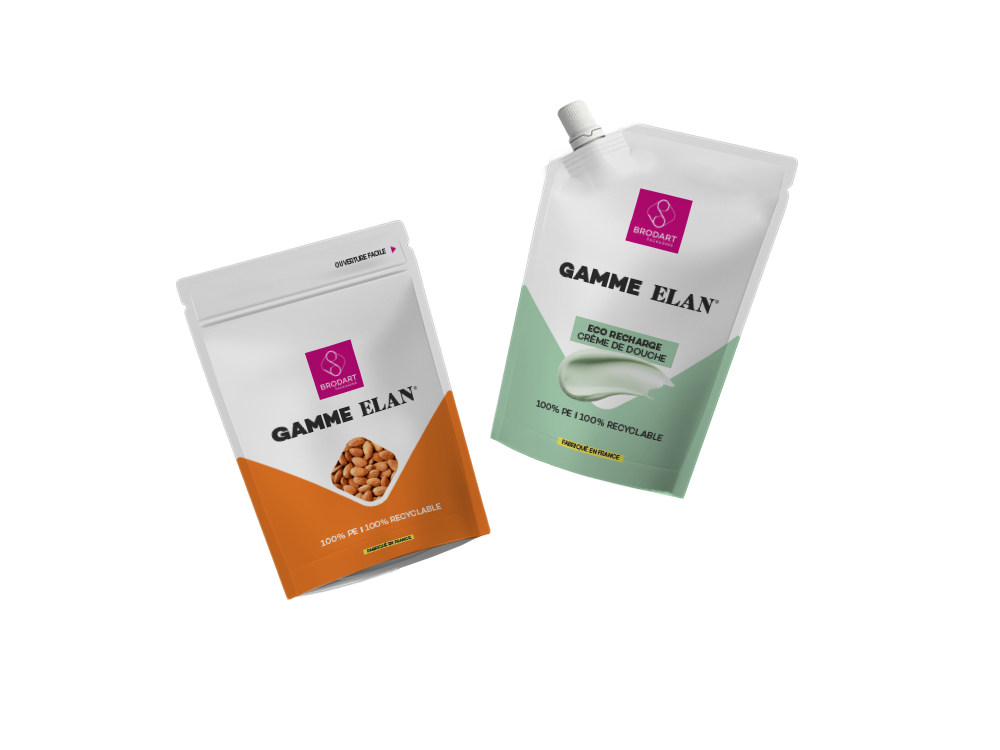
The doypack or stand-up pouch, also known as a flexible sachet, is a packaging product distinguished by its practical shape and ease of use. It is mainly used to package products such as fresh cream, shower products, coffee, tea and infusion refills. Its ability to stand upright makes it very practical for storage, and its hermetic closure system preserves food freshness. What's more, doypack is a lightweight, space-saving package, making it ideal for transport and travel. Its compact, flexible format makes it perfect for use on the move.
What is a monomaterial in packaging?
A monomaterial is a packaging made from a single type of polymer, such as polypropylene (PP) or polyethylene (PE). Unlike conventional multi-layer laminates, which combine several materials that are difficult to separate and recycle, monomaterials present a homogeneous structure that is perfectly suited to existing mechanical recycling channels.
What are the advantages for manufacturers and parapharmaceutical manufacturers?
- Regulatory compliance: meets the requirements of the European directive on recyclable packaging.
- Optimized recyclability: facilitates separation into a single material stream, increasing the recovery rate.
- Reduced environmental impact: fewer complex residues, clearer traceability, and less final waste.
- Superior technical performance: guaranteed moisture and oxygen barrier and mechanical resistance thanks to new developments in mono-PP or mono-PE films.
A strategic choice for sustainable purchasing
For purchasing managers in charge of food packaging or parapharmaceutical products, incorporating monomaterials into your specifications means :
- anticipate market and regulatory developments,
- promote your products to committed distributors,
- strengthen your CSR policy without compromising on quality.
Monomaterials: the key to more recyclable packaging
The PPWR, which came into force on February 11, 2025, requires all packaging on the European market to be economically recyclable by 2030.In this context, monomaterials, composed of a single type of polymer such as polypropylene (PP) or polyethylene (PE), are ideally suited to end-of-life separation and processing requirements.
Today, the situation in Europe speaks for itself: in 2022, the Union generated 83.4 million tonnes of packaging, or 186.5 kg per capita, of which only 41% of plastic packaging is recycled. For plastics, the European target is to increase this figure from 41% to 55% by 2030.
By adopting mono PP or mono PE packaging, manufacturers benefit from a unified, highly recoverable material flow, simplifying collection and the recycling chain. They anticipate regulatory obligations while significantly improving their recycling rate, which is currently too low for plastics.
The use of monomaterials therefore appears to be a winning strategy for meeting PPWR challenges, improving CSR performance and positioning the company as a benchmark player in sustainability.
Sources: packagingeurope.com


 CONTACT US